For professional landscapers, the best commercial pole saws for 2026 balance cutting-edge technology with proven durability, offering powerful and precise solutions for high branches and extensive tree maintenance. Top models include the Stihl HTA 135 (battery) for its exceptional cutting speed and balance, and the Stihl HT 135 (gas) for raw power and extended runtime. These tools are indispensable for efficient work and worker safety, allowing overhead tasks without the risks of ladders or bucket trucks.
Pole Saw: What It Is and Why Landscapers Need It
A pole saw is essentially a chainsaw or pruning blade mounted on an extended pole, specifically designed to cut branches from the ground or a stable platform. This ingenious tool revolutionizes tree and shrub maintenance by providing exceptional reach and cutting power. Landscapers frequently use pole saws for a variety of critical tasks, from routine pruning of ornamental trees and clearing overgrown hedges to more demanding jobs like removing storm-damaged limbs or maintaining clear lines along property boundaries and trails.
The primary advantage of using a pole saw over traditional chainsaws or manual pruners, particularly in a commercial setting, is the significant improvement in safety and efficiency. It eliminates the need for climbing ladders for many tasks, greatly reducing the risk of falls and other job-site accidents. Furthermore, with the right pole saw, a landscaper can execute clean, precise cuts quickly, saving valuable time and labor costs on extensive projects. The extended reach also allows for better visibility of the cutting area, leading to more aesthetically pleasing results and healthier tree growth.
Types of Commercial Pole Saws: Finding Your Perfect Match
Commercial pole saws come in various power configurations, each offering distinct advantages and trade-offs tailored to different landscaping demands. Understanding these types is crucial for selecting the model that best suits your specific operational needs.
Battery-Powered Pole Saws
Battery-powered pole saws have rapidly advanced, now offering performance that rivals many gas models while providing numerous environmental and operational benefits.
- Key Advantages: These saws are notably quieter, making them ideal for work in noise-sensitive areas like residential neighborhoods or public parks. They produce zero emissions, aligning with growing environmental regulations and offering a healthier work environment. With less maintenance compared to gas counterparts (no fuel mixing, oil changes, or carburetor issues), battery pole saws offer grab-and-go convenience. Many are also part of larger battery ecosystems, allowing landscapers to interchange batteries with other tools from the same brand.
- Key Disadvantages: The primary limitation is runtime, which is dictated by battery capacity. While batteries are improving, prolonged, heavy-duty use may require multiple batteries or planned charging breaks. They can also be expensive upfront, particularly for high-voltage systems and multiple battery packs.
- Suitable Applications: Excellent for daily trimming, light to medium pruning tasks, and jobs where noise and emissions are a concern. High-voltage, professional-grade battery saws can now handle substantial branches, making them versatile for many commercial operations.
Gas-Powered Pole Saws
For sheer power and extended operation in demanding conditions, gas-powered pole saws remain a staple in many commercial landscaping fleets.
- Key Advantages: Gas models typically deliver superior torque and cutting force, making quick work of thicker, tougher branches. They offer unlimited runtime as long as you have fuel on hand, which is invaluable for all-day jobs on large properties or clearing extensive brush. Their robust nature is often preferred for heavy-duty professional work and situations where maximum power is non-negotiable.
- Key Disadvantages: Gas pole saws are significantly louder and produce exhaust fumes, which can be an issue in certain environments or for operator comfort. They require more maintenance, including fuel mixing, spark plug changes, air filter cleaning, and carburetor adjustments. They are also generally heavier than battery-powered models, leading to increased operator fatigue over long periods.
- Suitable Applications: Best for large-scale landscaping, tree removal, clearing storm debris, and any situation requiring continuous, high-power cutting of substantial limbs.
Manual Pole Saws
While not typically considered “commercial” in the same vein as powered options, manual pole saws still have a niche. They consist of a blade (often a curved pruning saw) on a long, extendable pole.
- Key Advantages: They are lightweight, quiet, inexpensive, and require no fuel or batteries. They are also maintenance-free beyond blade sharpening.
- Key Disadvantages: They demand significant physical effort, are much slower, and are only suitable for smaller, lighter branches.
- Suitable Applications: Very limited for commercial use, perhaps only for highly selective, light pruning in extremely quiet environments or where access to power is impossible. For the vast majority of commercial landscaping, powered options are a necessity.
Top Commercial Pole Saw Brands: A Head-to-Head Comparison
The commercial landscaping market is dominated by several reputable brands known for their durable and high-performing equipment. When investing in a pole saw for your business, these brands consistently rise to the top.
- Stihl: A powerhouse in outdoor power equipment, Stihl is synonymous with professional-grade tools. Their commercial pole saws, both gas and battery, are praised for their robust construction, exceptional power, and long-term durability. Stihl models like the HTA 135 (battery) and HT 135 (gas) are often top contenders, known for smooth operation and aggressive cutting. However, this premium performance often comes with a higher price tag.
- Echo: Echo also maintains a strong presence in the commercial sector, offering a range of reliable gas and battery pole saws. Echo models are recognized for their strong engines, solid build quality, and good value proposition. The Echo X Series DPPT 2600H battery pole saw and the PPF 2620 gas model are frequently highlighted for their performance and durability in demanding conditions.
- Husqvarna: With a long history of manufacturing professional forestry and garden tools, Husqvarna provides pole saws known for their ergonomic design, excellent balance, and strong cutting capabilities. Models such as the Husqvarna 525P4S are often cited for their user-friendliness and reliable performance, featuring innovations like air purge systems for easy starting.
- DeWalt: Primarily known for its extensive line of power tools, DeWalt has made significant inroads into outdoor power equipment with its robust battery platforms. DeWalt commercial pole saws, like the 20V MAX XR, leverage their existing battery ecosystems, offering convenience and consistent power for contractors already invested in the brand. They are often lauded for their balance and ease of use.
- Makita: Similar to DeWalt, Makita extends its reputation for professional-grade battery tools into pole saws. The Makita DUA301Z, part of their 18V X2 (36V) LXT platform, is designed for professionals needing powerful and precise cordless solutions. Users appreciate their high cutting efficiency and strong build.
- EGO Power+: EGO has emerged as a leader in high-performance battery-powered outdoor equipment, often matching or exceeding gas performance in certain categories. Their commercial pole saws, such as the EGO Power+ PSA1000, are celebrated for their powerful brushless motors, ergonomic designs, and carbon fiber shafts that offer strength without excessive weight.
- Milwaukee: Another strong contender from the battery-powered tool market, Milwaukee’s M18 Fuel line offers pole saws known for their versatility, rapid cutting speed, and overall value. They cater to professionals who need reliable, quick-deployment tools that integrate seamlessly with their existing Milwaukee battery platforms.
These brands consistently deliver the quality, performance, and support that commercial landscapers demand. While each has its unique strengths, the choice often comes down to specific feature preferences, existing tool ecosystems, and budget.
Detailed Comparison Table: Leading Commercial Pole Saw Models
For landscapers seeking the best tools for their trade, a direct comparison of leading models is essential. This table highlights top commercial pole saws from trusted brands for 2026, showcasing their key features, advantages, and considerations.
| Model Name | Type | Max Reach (ft) | Power Source | Key Advantages | Key Disadvantages | Price Range (USD) |
|---|---|---|---|---|---|---|
| Stihl HTA 135 | Battery | 11.5 | 36V | Powerful, excellent balance, low vibration, variable speed | Heaviest battery model, high initial cost | $1,000+ |
| Echo X Series DPPT 2600H | Battery | 11 | 56V | Solid feel, heavy-duty, variable speed, durable construction | Slightly less nimble than Stihl HTA 135 | $800+ |
| Stihl HT 135 | Gas | 13 | 36.3cc Gas | High power for thick limbs, robust, professional-grade | Heavier, noisier, requires fuel mixing and more maintenance | $700+ |
| Husqvarna 525P4S | Gas | 13 | 25.4cc Gas | Excellent ergonomics, superior balance, easy starting (air purge) | Lower displacement than some gas models, potentially less power for very thick branches | $700+ |
| DeWalt 20V MAX XR | Battery | 15 | 20V | Great reach, user-friendly, part of extensive battery ecosystem, lightweight | May not match gas power for continuous heavy clearing | $300-$500 (tool only) |
| Makita DUA301Z | Battery | 12 (approx.) | 18V X2 (36V) | High cutting efficiency, professional precision, robust build | Requires Makita LXT batteries, potentially high initial cost for new users | $500-$700 (tool only) |
| Milwaukee M18 Fuel | Battery | 8.75 | 18V | Versatile, fast cutting speed, good value, quick-lok attachments | Shorter maximum reach compared to other professional models | $500 (kit) |
| EGO Power+ PSA1000 | Battery | 12 | 56V | Pro-grade power, carbon fiber shaft, ergonomic, efficient | Specific battery system, may require separate power head purchase | $200-$400 (attachment/tool only) |
Commercial Pole Saw Buying Guide: What Landscapers Must Consider
Choosing the right commercial pole saw requires careful consideration of several factors to ensure it meets the rigorous demands of professional landscaping. A well-chosen tool enhances productivity, ensures safety, and proves a valuable asset for years.
Reach and Accessibility
The primary function of a pole saw is to extend your reach, making this a paramount consideration. Landscapers need to assess the typical height of branches they prune. Pole saws come with varying maximum lengths, often extending from 8 to over 15 feet when combined with the operator’s height.
- Telescoping vs. Fixed Poles: Telescoping poles offer greater versatility, allowing adjustment for different cutting heights and easier storage. Fixed-length poles, while less adaptable, can sometimes offer more rigidity at maximum extension. Ensure the pole’s material (fiberglass or aluminum) provides sufficient rigidity without excessive flex, especially when fully extended.
Power Type and Performance
The choice between gas and battery power significantly impacts performance and operational logistics for commercial users.
- Gas-Powered: Ideal for heavy-duty work, large properties, and continuous operation where raw power and unlimited runtime are critical. Look for engine displacement (cc) that indicates power. Higher cc typically means more power, essential for cutting thick, dense wood.
- Battery-Powered: Excellent for noise-sensitive areas, urban environments, and jobs requiring easy startups and less maintenance. Consider battery voltage (V) for power and amp-hours (Ah) for runtime. For commercial use, higher voltage (e.g., 36V, 56V, 80V) and higher Ah batteries are preferable to ensure sufficient power and duration. Many professionals now find high-end battery models capable of gas-like performance.
Weight and Maneuverability
Holding a pole saw overhead for extended periods can be physically demanding. The tool’s weight and balance are crucial for reducing operator fatigue and increasing control.
- Balance: A well-balanced pole saw distributes weight evenly, making it feel lighter and easier to maneuver, especially at full extension.
- Ergonomics and Anti-Vibration: Features like ergonomic handles, padded grips, and anti-vibration technology significantly improve comfort during long workdays. Lighter overall weight is always a plus, but it must not compromise durability or power.
Safety Features
Safety is non-negotiable in commercial landscaping. Pole saws, like chainsaws, demand respect and appropriate safety measures.
- Automatic Oiler: Ensures the chain and bar are constantly lubricated, preventing overheating and promoting smoother cuts.
- Low Kickback Chains and Bars: Designed to reduce the force of kickback, enhancing safety.
- Safety Locks: Prevent accidental startups, a critical feature for powered models.
- Harnesses: Shoulder straps or harnesses can help distribute the tool’s weight, reducing strain and offering better control, especially with heavier gas models. Always read the instruction manual and use appropriate Personal Protective Equipment (PPE).
Durability and Serviceability
For professionals, a tool must withstand daily abuse and be easily repairable. Downtime costs money.
- Commercial-Grade Construction: Look for robust materials and solid construction that can endure harsh job site conditions.
- Service Network and Parts Availability: Access to replacement parts, certified service centers, and a strong warranty is vital for long-term ownership. Brands with established professional networks offer peace of mind.
Cost and Value
The initial purchase price is a factor, but landscapers should also consider the total cost of ownership.
- Initial Investment: Gas saws might have a lower entry cost, but battery systems can be more expensive upfront, especially if you’re buying batteries and chargers for a new platform.
- Long-Term Operating Costs: Gas saws incur ongoing fuel and oil costs, plus more frequent maintenance expenses. Battery saws have electricity costs for charging but generally lower maintenance.
- Battery System Compatibility: If you already own other tools from a particular brand’s battery ecosystem (e.g., DeWalt 20V MAX, Milwaukee M18), investing in a compatible pole saw can offer significant value by reducing the need for additional batteries and chargers.
Top Picks: Most Recommended Commercial Pole Saws for 2026
Based on power, reach, durability, and professional suitability, these pole saws stand out as top recommendations for landscapers in 2026.
1. Stihl HTA 135 (Best Overall Battery-Powered)
The Stihl HTA 135 is a powerhouse for professionals seeking battery convenience without compromising performance. It delivers exceptional cutting speed and balance, making it intuitive to use despite its weight. Its impressive 11.5-foot extension allows for significant reach, and its smooth operation zips through limbs with remarkable ease. While it represents a significant investment, its robust build and powerful performance justify the cost for dedicated commercial use.
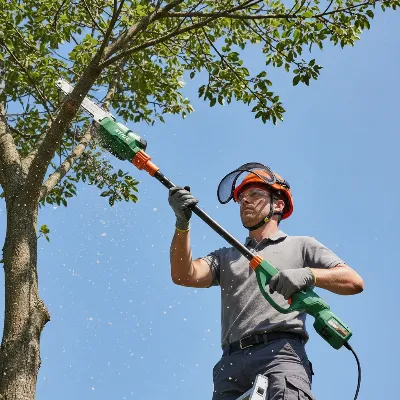 Stihl HTA 135 battery pole saw used by a professional landscaper trimming high branches
2. Stihl HT 135 (Best Overall Gas-Powered)
For those who prefer the raw power and extended runtime of gasoline, the Stihl HT 135 stands as a top-tier choice. Equipped with a 36.3 cc engine and a 14-inch bar, this gas pole pruner is built for the toughest jobs, easily tackling thick branches. Its sturdy drive shaft and heavy aluminum pole ensure stability and dampen vibrations, leading to cleaner cuts and reduced fatigue. The HT 135 is a durable workhorse designed to handle demanding professional-level execution.
3. DeWalt 20V MAX XR Cordless Pole Saw (Best Value Battery / Ecosystem)
The DeWalt 20V MAX XR is an excellent choice for landscapers already invested in DeWalt’s battery ecosystem or those seeking a highly user-friendly and dependable cordless option. With an impressive maximum reach of 15 feet, it allows for trimming high branches without a ladder. The efficient brushless motor provides consistent power, and its well-balanced design makes it comfortable for extended use. It’s a rugged and reliable tool, perfect for diverse landscaping tasks.
4. Echo X Series DPPT 2600H (Heavy-Duty Battery Alternative)
The Echo X Series DPPT 2600H is a formidable battery-powered contender, offering heavy-duty performance that directly competes with the Stihl HTA 135. This pole saw boasts a solid feel, with a sturdy pole that minimizes wobble even when fully extended, making it easier to cut large limbs at height. Its variable speed control near the trigger allows for precise power adjustments. For professionals needing a powerful and durable battery solution, the Echo X Series is an outstanding choice.
5. Makita DUA301Z (High-Performance Cordless)
The Makita DUA301Z is engineered for professionals who demand both power and precision from a cordless tool. Part of Makita’s LXT® 18V X2 platform, this model delivers exceptional cutting efficiency. Its advanced brushless motor technology and robust construction ensure it can handle challenging jobs in arboriculture and landscaping. If you’re a Makita user, this high-performance telescoping pole saw is a perfect addition for elevated pruning and trimming tasks.
Proper Use and Maintenance for Longevity
To ensure your commercial pole saw delivers reliable performance and lasts for years, proper use and diligent maintenance are critical.
Safe Operation Guidelines:
- Personal Protective Equipment (PPE): Always wear safety glasses, hearing protection, gloves, a hard hat, and sturdy, non-slip footwear. Consider chaps for added protection.
- Clear Workspace: Before starting, ensure the area around and beneath the target branch is clear of people, pets, and obstacles. Plan your escape route for falling branches.
- Proper Stance: Maintain a stable, balanced stance. Hold the pole saw firmly with both hands, keeping your feet shoulder-width apart. Avoid overreaching or cutting above shoulder height whenever possible, as this can lead to loss of control and fatigue.
- Branch Assessment: Carefully assess the branch’s diameter, angle, and potential fall path. Use the “three-cut method” for larger branches (an undercut, then a top cut, followed by a final flush cut) to prevent bark stripping.
- Electrical Hazards: Always be aware of power lines. Maintain a safe distance, typically at least 10 feet, from all electrical wires. If in doubt, contact professionals.
Maintenance Tips:
- Cleaning: After each use, clean the saw blade, bar, and chain. Remove any sap, sawdust, and debris. For gas models, clean air filters regularly.
- Chain Sharpening and Oiling: A sharp chain cuts efficiently and safely. Sharpen the chain regularly or replace it when dull. For powered saws, ensure the automatic oiler is functioning correctly and keep the oil reservoir filled with the appropriate bar and chain oil.
- Fuel/Battery Care: For gas saws, use the correct fuel mixture and store fuel properly. Drain fuel for long-term storage. For battery saws, keep batteries charged and stored in a cool, dry place. Avoid extreme temperatures.
- Pole Inspection: Regularly inspect the pole for cracks, damage, or wear, especially on telescoping mechanisms.
- Storage: Store your pole saw in a clean, dry location, out of reach of children.
Adhering to these guidelines not only prolongs the life of your equipment but, more importantly, ensures the safety of the operator and those around the workspace.
 Professional landscaper performing maintenance on a pole saw
Frequently Asked Questions
What is the typical reach of a commercial pole saw?
Commercial pole saws typically offer a maximum working reach ranging from 8 to over 15 feet, often including the operator’s height. This reach allows landscapers to safely trim elevated branches without needing ladders, significantly improving safety and efficiency on job sites.
How often should a commercial pole saw chain be sharpened?
The frequency of chain sharpening depends on usage and the type of wood being cut. For commercial use, chains should be inspected and sharpened regularly, ideally after every few hours of continuous operation or immediately if cutting performance declines, the saw produces sawdust instead of chips, or it struggles to cut.
Are battery-powered pole saws powerful enough for commercial landscaping?
Yes, modern high-voltage (e.g., 36V, 56V, 80V) battery-powered pole saws are increasingly powerful enough for many commercial landscaping tasks. They offer performance comparable to gas models for medium to heavy-duty pruning, especially with brushless motors and high-capacity batteries.
What safety gear is essential when using a pole saw?
Essential safety gear includes safety glasses, hearing protection, work gloves, a hard hat, and sturdy, non-slip work boots. Depending on the task and tool, chaps may also be recommended to protect against cuts.
How does a gas pole saw differ from a battery pole saw in terms of maintenance?
Gas pole saws require more intensive maintenance, including fuel mixing, regular cleaning or replacement of air filters, spark plug changes, and carburetor adjustments. Battery pole saws have simpler maintenance, primarily focusing on keeping the chain sharp and oiled, and proper battery care, with no engine-related servicing.
Frequently Asked Questions
What is the typical reach of a commercial pole saw?
Commercial pole saws typically offer a maximum working reach ranging from 8 to over 15 feet, often including the operator's height. This extended reach allows landscapers to safely trim elevated branches without needing ladders, significantly improving safety and efficiency on job sites.
How often should a commercial pole saw chain be sharpened?
The frequency of chain sharpening depends on usage and the type of wood being cut. For commercial use, chains should be inspected and sharpened regularly, ideally after every few hours of continuous operation or immediately if cutting performance declines, the saw produces sawdust instead of chips, or it struggles to cut.
Are battery-powered pole saws powerful enough for commercial landscaping?
Yes, modern high-voltage (e.g., 36V, 56V, 80V) battery-powered pole saws are increasingly powerful enough for many commercial landscaping tasks. They offer performance comparable to gas models for medium to heavy-duty pruning, especially with brushless motors and high-capacity batteries.
What safety gear is essential when using a pole saw?
Essential safety gear includes safety glasses, hearing protection, work gloves, a hard hat, and sturdy, non-slip work boots. Depending on the task and tool, chaps may also be recommended to protect against cuts.
How does a gas pole saw differ from a battery pole saw in terms of maintenance?
Gas pole saws require more intensive maintenance, including fuel mixing, regular cleaning or replacement of air filters, spark plug changes, and carburetor adjustments. Battery pole saws have simpler maintenance, primarily focusing on keeping the chain sharp and oiled, and proper battery care, with no engine-related servicing.
Proper Use and Maintenance for Pole Saw Longevity
To ensure your commercial pole saw delivers reliable performance and lasts for years, proper use and diligent maintenance are critical for both safety and equipment longevity.
Always wear safety glasses, hearing protection, gloves, a hard hat, and sturdy, non-slip footwear. Consider chaps for added protection against cuts and impacts during operation.
Before starting, ensure the area around and beneath the target branch is clear of people, pets, and obstacles. Plan your escape route for falling branches to prevent accidents.
Maintain a stable, balanced stance with feet shoulder-width apart, holding the pole saw firmly with both hands. Avoid overreaching or cutting above shoulder height whenever possible to prevent loss of control and fatigue.
After each use, clean the saw blade, bar, and chain, removing sap, sawdust, and debris. Sharpen the chain regularly or replace it when dull to ensure efficient and safe cutting performance.
For gas saws, use the correct fuel mixture and store fuel properly, draining it for long-term storage. For battery saws, keep batteries charged and stored in a cool, dry place, avoiding extreme temperatures. Store your pole saw in a clean, dry location, out of reach of children.

We recently upgraded to the Stihl HT 135 gas model, and the raw power is exactly what we needed for those really tough jobs. It’s a bit heavier than our old electric one, but the extended runtime means we’re not constantly stopping to recharge. Definitely a solid investment for serious tree maintenance.
I’ve been using the Stihl HTA 135 for a few months now, and it’s a game-changer for my landscaping business. The battery life is surprisingly good, and the balance makes it much less fatiguing to use for extended periods. It really does make quick work of high branches without needing a ladder, which is a huge safety improvement for my crew.
I picked up one of the commercial pole saws in the mid-range price point, around $500-$700, and while it gets the job done, the cutting speed isn’t quite as fast as I’d hoped. It’s decent for smaller branches, but anything thicker takes a bit more effort. Still, it’s better than climbing a ladder.
The durability of these commercial pole saws is no joke. We put our equipment through a lot, and the one I got has held up perfectly. It’s great to have a tool that can handle extensive tree maintenance without showing signs of wear and tear after just a few jobs. Highly recommend for any professional.