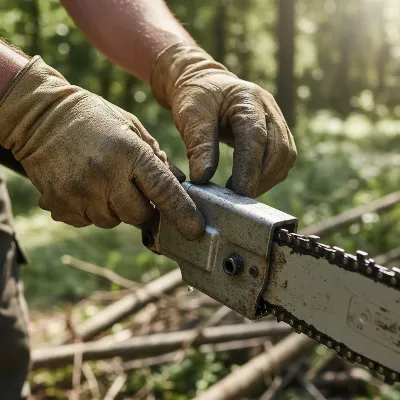
Is your pole saw struggling to slice through branches, leaving ragged edges and demanding extra effort? A dull chain is not only inefficient but can also be dangerous, increasing the risk of kickback and injury. Maintaining a sharp blade is crucial for both the longevity of your tool and the pristine health of your garden. This comprehensive guide will walk you through the simple yet essential steps to safely sharpen your pole saw chain right in your own home, restoring its cutting prowess and making your pruning tasks a breeze. We’ll explore the necessary tools, techniques, and safety precautions to ensure you achieve a razor-sharp edge with confidence.
Understanding Your Pole Saw Chain and Why Sharpening Matters
A pole saw chain is a series of interconnected teeth designed to efficiently cut wood. Each tooth, or “cutter,” has two main angles: the top plate cutting angle and the side plate cutting angle, along with a depth gauge (or raker) that controls how deep the cutter can penetrate the wood. Over time, these sharp edges become rounded or nicked due to contact with wood, dirt, or even small stones, leading to a dull chain.
Sharpening is not just about making the saw cut faster; it’s about making it cut better and safer. A sharp chain glides through wood, producing clean sawdust. A dull chain, however, tears at the wood, producing fine dust or wood shavings, and forces you to apply more pressure, leading to operator fatigue, excessive fuel consumption (for gas models), and potential damage to the saw’s engine or motor. More importantly, a dull chain is prone to kickback, a violent and sudden backward thrust of the saw, which can cause serious injury. Regular sharpening extends the life of your chain, improves cutting efficiency, and significantly enhances safety during operation.
Essential Tools for Sharpening Your Pole Saw Chain
Before you begin, gather the right tools. Having everything at hand will make the process smoother and more efficient.
- Round File: The most crucial tool. The size of the round file must precisely match the diameter of your pole saw chain’s cutters. This information is usually stamped on the chain itself, on the saw’s guide bar, or found in your saw’s owner’s manual. Common sizes range from 5/32″ (4.0mm) to 3/16″ (4.8mm) for typical pole saw chains.
- Flat File (Depth Gauge File): Used to file down the depth gauges (rakers) after the cutters have been sharpened. This ensures proper cutting depth.
- File Guide/Holder: This accessory attaches to your round file and helps maintain the correct filing angle (typically 25-35 degrees, also found in your manual) and depth. It’s highly recommended, especially for beginners, to ensure consistent sharpening.
- Depth Gauge Tool: A small metal template with a slot that helps you check and file down the depth gauges to the correct height.
- Chain Vise or Workbench Clamp: Essential for securely holding the pole saw’s guide bar and chain in place while you sharpen. Stability is key for safety and accuracy.
- Work Gloves: To protect your hands from sharp edges.
- Safety Glasses: To shield your eyes from metal filings and debris.
- Wire Brush or Old Toothbrush: For cleaning sawdust and debris from the chain before sharpening.
- Marker Pen: To mark the starting tooth, ensuring you sharpen every cutter.
> “Using the correct file size and maintaining the prescribed sharpening angle are the two most critical factors for achieving a truly sharp and effective saw chain. Skipping these details can lead to an uneven cut and reduce your saw’s performance.” – John Miller, Arborist and Power Tool Specialist
Step-by-Step Guide to Sharpening Your Pole Saw Chain
Follow these steps carefully to achieve a uniformly sharp chain.
Step 1: Prepare Your Pole Saw for Sharpening
|
Our Picks for the Best Pole Saw in 2026
As an Amazon Associate I earn from qualifying purchases.
|
||
| Num | Product | Action |
|---|---|---|
| 1 | SEESII 10-Inch 2-in-1 Cordless Pole Saw & Mini Chainsaw, 21V Battery Powered Brushless Electric Tree Trimmer with Extension Pole, 2×4000mAh Batteries, Automatic Oiling,Handheld Pruner |

|
| 2 | Fiskars 15" Replacement Saw Blade, Woodzig Chainsaw Tooth, Compatible Models 9300/9261/TP45, Silver |
|
| 3 | 36FT Pole Saw, Telescoping Tree Trimmer with 7-30FT Extension Pole, Manual Branches Pruner for Backyard, Blue |
|
| 4 | 12-Inch Chain, Pole Saw Attachment - Compatible with Weed Eater Snapper Craftsman Ryobi WORX Troy-Bilt, and Homelite Multi-Tool Hus 128LD |
|
| 5 | Greenworks 8-Inch 40V Pole Saw Attachment PS40A00 |
|
| 6 | Pole Saw Attachment + Extension Pole Attachment Compatible with 125LDx 128DJx 128LDx 323LD 324LDx 325LDx 326LDx and 327LDx power head or trimmer head Silvery PA1100 575261201 |
|
| 7 | Kerlista Replacement Pole saw Attachment compatible with Weed Eater Snapper dewalt Craftsman Ryobi John Deere Worx Troy-Bilt and Homelite multi-tool Hus 28LD Power head Black |
|
| 8 | Kerlista Replace part Pole saw attachment + Extension Pole Attachment compatible with Hus 128LD most brushcutters head and Powerheads (Black) |
|
| 9 | Pole Saw Bag Compatible with Dewalt/Worx/Greenworks/EGO Power+/Black+Decker Electric Telescoping Chainsaw, Cordless Power Saw Storage Case for Extension Tree Trimmer Attachment, Black&Yellow |
|
| 10 | Electric 2-in-1 Cordless Pole Saw & 6" Chainsaw, Brushless Pruning Saw with 3.0Ah Battery, 15-Foot Reach Extendable Tree Trimmer for High Branch Pruning & Limb Cutting |
|
- Safety First: Ensure the pole saw is turned off and disconnected from its power source (unplug electric models, remove battery from cordless models, disconnect spark plug wire from gas models). Wear your work gloves and safety glasses.
- Clean the Chain: Use a wire brush or old toothbrush to thoroughly clean any sawdust, sap, or debris from the chain. A clean chain allows for better visibility and more accurate filing.
- Secure the Pole Saw: Securely clamp the pole saw’s guide bar in a chain vise or workbench clamp. The chain needs to be stable and unable to move while you work.
- Identify the Starting Tooth: Use a marker pen to mark one of the cutters. This will help you keep track of which teeth you’ve sharpened and ensure you don’t miss any or sharpen any twice.
- Determine Filing Direction: Notice that saw chains have two types of cutters: those that cut right and those that cut left. They alternate around the chain. You will sharpen all the cutters facing one direction first, then flip the saw (or move around it) and sharpen the other set.
Step 2: Sharpening the Cutters with a Round File
- Position the File: Place the correct size round file into the gullet (the space between the cutter and the depth gauge) of your marked tooth.
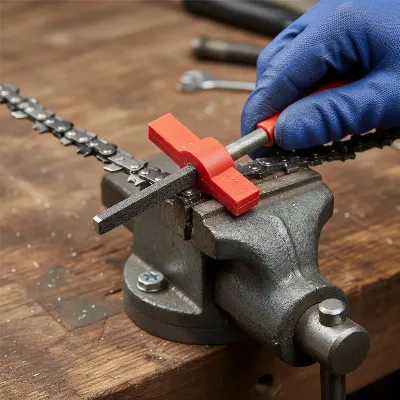 Close-up of a hand using a round file with a guide to sharpen a pole saw chain tooth
 - Maintain the Correct Angle: If using a file guide, ensure it rests firmly on the top plate and depth gauge. Push the file at the correct angle (typically 25-35 degrees, as specified in your manual). This angle is crucial for the cutter’s efficiency. Many file guides have markings to help you achieve this.
- File with Even Strokes: Use smooth, firm, outward strokes away from your body. Lift the file slightly on the return stroke to prevent dulling its teeth. Apply consistent pressure.
- Count the Strokes: Perform 3-5 strokes on the first tooth. The goal is to remove any damage and achieve a sharp, shiny edge.
- Check for Consistency: Move to the next tooth that cuts in the same direction. Repeat the same number of strokes, ensuring each tooth receives uniform treatment. This maintains balance in the chain.
- Work Around the Chain: Continue sharpening all the teeth that cut in one direction until you reach your marked starting tooth.
- Flip and Repeat: Once all teeth facing one way are sharpened, unclamp, flip the saw, and re-clamp it. Then, sharpen all the teeth that face the opposite direction, again using the same number of strokes for consistency.
Step 3: Adjusting the Depth Gauges (Rakers)
After sharpening the cutters, the depth gauges will now be relatively higher, as the cutter teeth have become shorter. If not lowered, the chain won’t cut efficiently.
- Place the Depth Gauge Tool: Position the depth gauge tool (raker gauge) over a sharpened cutter. The part of the depth gauge that needs to be filed down will protrude slightly through the slot in the tool.
- File Down the Raker: Using a flat file, carefully file down the protruding depth gauge until it’s flush with the depth gauge tool. File horizontally across the top of the raker.
- Maintain Rounded Edge: Some depth gauges have a slight curve at the front. After filing, gently round off the front edge of the depth gauge with a few light strokes of the flat file, ensuring a smooth transition into the wood.
- Repeat for All Rakers: Move around the entire chain, checking and filing down each depth gauge.
Step 4: Final Inspection and Maintenance
- Check for Sharpness: A properly sharpened tooth should have a sharp, clean edge that feels almost “catchy” when you lightly run your fingernail across it (be very careful!). There should be no shiny spots left on the cutting edge.
- Clean and Lubricate: Use a wire brush to remove any remaining metal filings. Then, apply chain oil to lubricate the chain before reassembling or using the pole saw.
- Test Cut: Before tackling a large project, make a test cut on a small piece of wood. A properly sharpened chain should cut smoothly and produce consistent, clean sawdust chips.
Important Safety Precautions When Sharpening
Sharpening a pole saw chain involves working with sharp edges and power tools. Always prioritize safety.
- Always Disconnect Power: Ensure the saw is completely de-energized before touching the chain.
- Wear PPE: Eye protection and heavy-duty gloves are non-negotiable.
- Stable Work Surface: A securely clamped guide bar prevents accidental slips and injuries.
- Correct File Size: Using the wrong file size can damage the chain and make it harder to sharpen correctly.
- Avoid Over-Filing: Each sharpening removes a small amount of metal. Over-filing shortens the life of your chain. Aim for minimal material removal to achieve sharpness.
- Don’t Rush: Take your time. Precision is more important than speed.
- Read Your Manual: Always consult your pole saw’s owner’s manual for specific chain and sharpening specifications, as designs can vary.
Conclusion
A sharp pole saw chain is the cornerstone of efficient and safe tree trimming. By understanding the basics of chain design, equipping yourself with the right tools, and meticulously following the sharpening steps, you can confidently restore your pole saw’s cutting performance at home. Regular maintenance, including sharpening and proper depth gauge adjustment, not only prolongs the life of your chain but also dramatically improves your cutting experience, making garden tasks less strenuous and significantly safer. Don’t let a dull blade slow you down or compromise your safety. Embrace the power of a perfectly sharpened chain and enjoy cleaner cuts and a healthier garden. What’s the most challenging pruning task you’re looking forward to tackling with your newly sharpened pole saw?
Frequently Asked Questions
How often should I sharpen my pole saw chain?
The frequency depends on usage and what you’re cutting. Generally, sharpen your chain after every few hours of cutting, or immediately if you hit dirt, rocks, or notice the saw producing fine dust instead of chips, or requiring more force to cut.
Can I sharpen a pole saw chain with a Dremel or grinding tool?
While possible, it’s generally not recommended for home users. Dremels or grinding tools can easily overheat the chain, causing it to lose its temper (hardness) and become brittle. They also make it harder to maintain consistent angles and depths, which is crucial for balanced cutting. Manual filing is safer and more precise for most DIYers.
What happens if I don’t adjust the depth gauges?
If the depth gauges (rakers) are too high after sharpening the cutters, the cutters won’t be able to penetrate the wood deeply enough. This results in the chain “skating” over the wood, inefficient cutting, excessive vibration, and a dull feeling, even if the cutter teeth themselves are sharp.
How do I know when my pole saw chain is beyond sharpening?
A chain is typically worn out when the cutter teeth are too short to effectively grab the wood, or when the entire chain (rivets, links) becomes loose or damaged beyond repair. If the wear marks on the top plate are almost gone, or if you’ve sharpened it so many times that the cutters are tiny nubs, it’s time for a replacement.
Can I sharpen a bent or damaged chain?
No. If the chain is bent, cracked, or severely damaged (e.g., from hitting metal), it’s unsafe to use or sharpen. Replace a damaged chain immediately to prevent serious injury and further damage to your Pole Saw.